Your body already knows how to heal.
Pandiculation: Definition & Meaning

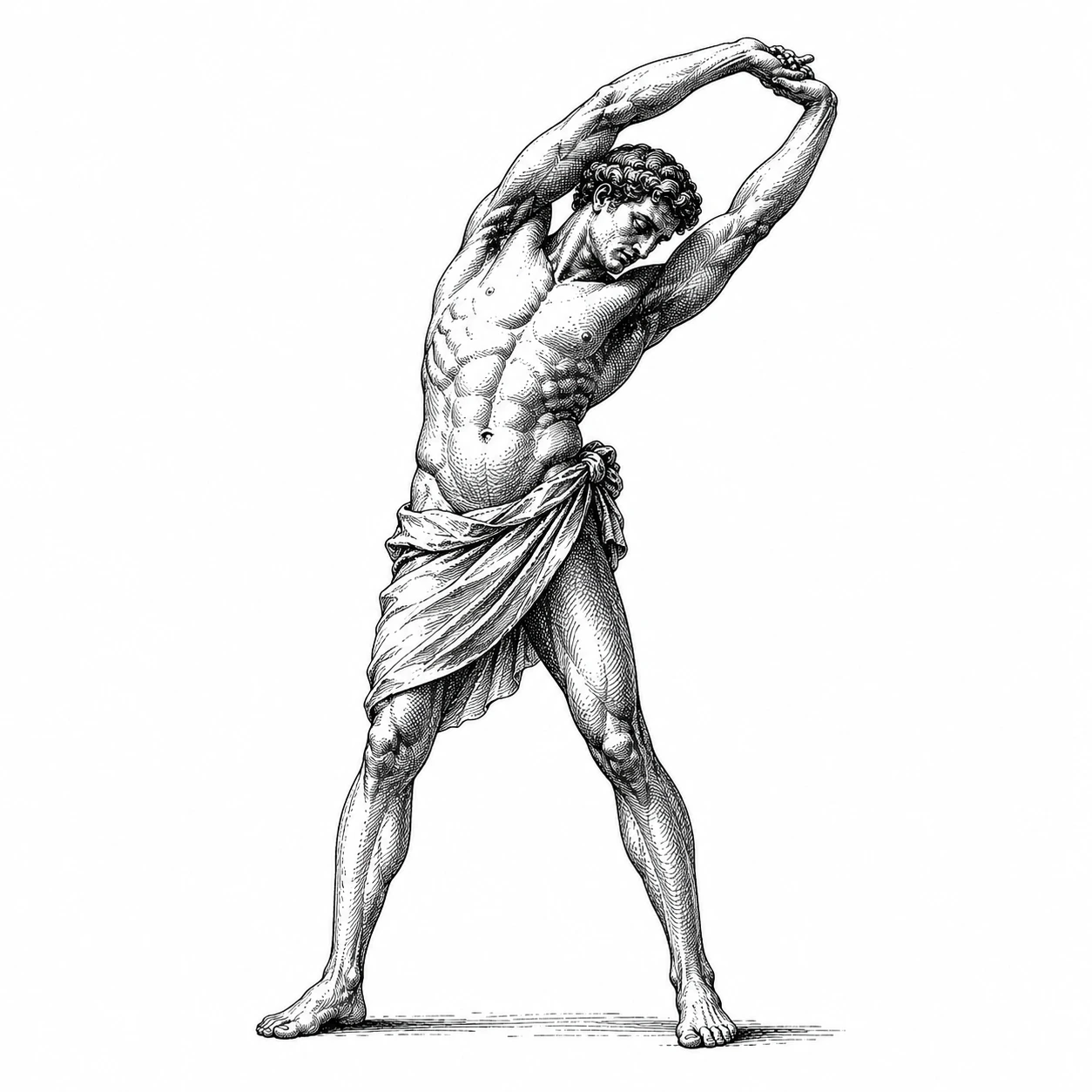
Pandiculation is the medical and scientific term for the involuntary act of stretching and stiffening the trunk and extremities, often accompanied by a yawn. It is a natural reflex, commonly seen in humans and animals upon waking or when drowsy, used by the nervous system to reset muscle tension and arouse the body.
People who live alongside cats and dogs witness pandiculation every single day, often without knowing there is a word for it. Pandiculation is the natural instinctive stretching response that commonly appears upon waking, frequently accompanied by yawning. It involves the lengthening and stiffening of the muscles and fascia in order to awaken, reorganize, and revitalize the body.
The term comes from the Latin pandiculatus, derived from pandere, meaning “to spread” or “to unfold,” the same linguistic root behind the word expand. In many ways, pandiculation is the body’s innate mechanism for returning itself to vitality, presence, and balance.
“
Pandiculation is a stretching and stiffening especially of the trunk and extremities, as when fatigued and drowsy or after waking from sleep.
How it Works
Unlike traditional static stretching, which relies on pulling or holding a muscle, pandiculation involves three active phases that retrain the brain-to-muscle connection:
- The Contraction: You actively contract a muscle that has been inactive or tense.
- The Slow Lengthening: You slowly and deliberately lengthen the muscle while maintaining a light contraction.
- The Release: You release completely, allowing the muscle to rest and reset to a relaxed state.

Benefits
In fields like clinical somatics, the pandicular response is considered vital for health. It naturally prevents muscles from becoming chronically tight, improves posture, and helps coordinate fluid movement throughout the body.
Some of the most important benefits include:
- Nervous system regulation: helps shift the organism from chronic stress and hypervigilance toward states of safety, calm, and parasympathetic restoration.
- Release of muscular tension: reduces chronic contraction patterns held unconsciously in the body.
- Fascial hydration and elasticity: supports the natural fluidity and adaptability of connective tissue.
- Emotional release: emotions stored through muscular bracing and nervous system activation may begin to discharge naturally.
- Improved body awareness: increases interoception and the ability to sense internal states more clearly.
- Restoration of natural movement patternsL: helps the body return to instinctive coordination and efficiency.
- Reduction of stiffness and fatigue: especially after prolonged sitting, stress, sleep, or repetitive movement patterns.
- Support for trauma recovery: may assist the body in completing incomplete defensive stress responses.
Breath expansion: encourages deeper and more spontaneous breathing patterns.
Presence and embodiment: reconnects awareness with the body and the immediate experience of being alive.
Pandiculation can be observed throughout nature. Cats, dogs, and many mammals instinctively pandiculate upon waking because the organism already knows how to restore itself through movement. In many ways, it is one of the body’s oldest forgotten languages.

After many years of yoga practice, and as explored in the article ‘Pandiculation and Yoga Connections’, I gradually came to the conclusion that the roots of yoga are profoundly natural and human. Not something that descended from the heavens or a sacred system in the sense of containing teachings from another dimension, but rather an intelligent observation of the body, breath, nature, and consciousness itself.
In this sense, I personally see pandiculation as the first form of yoga. An instinctive and primordial movement through which the organism restores itself naturally, long before philosophy, religion, or spiritual systems were created around it.
For me, pandiculation has functions that go far beyond the classical mind-body model. It also works deeply on the energetic level, helping movement, breath, emotion, and internal flow reorganize simultaneously. Pandiculation is like a “whole-body yawn.” It does not require complicated philosophy, flexibility, or years of preparation. The body already knows how to do it instinctively.
Within the Somatic Shaking™ system, this is the way I approach pandiculation:
- Notice the spontaneous urge to stretch emerging from within the body.
- Allow the inhalation to happen naturally, together with a feeling of internal expansion, almost like the body inflating from the inside out.
- Let the movement remain organic rather than forced.
- If tremors or shaking begin to appear, allow them without controlling them.
- Notice the brief suspension of breath and stillness while the body reorganizes itself internally.
- At the end, a spontaneous sigh or release often appears naturally, leaving behind a feeling of restoration and regulation.
At first, you may not feel a strong sense of internal expansion because of tension, fascial restrictions, or habitual protective patterns stored within the body. Bringing awareness into the lower back, pelvis, and spine can significantly improve this sensation of expansion from within.
“
Over time, pandiculation becomes less of an exercise and more of a dialogue with the intelligence of the organism itself.
Tags
# brain-to-muscle connection# clinical somatics# how to pandicate# kundalini awakening tremors# kundalini energy release# kundalini integration# kundalini syndrome shaking# muscle tension release# nervous system regulation# nervous system trauma response# pandicular response# pandiculation definition# pandiculation meaning# pandiculation reflex# pandiculation vs stretching# releasing trapped trauma in body# somatic experiencing shaking# somatic shaking trauma# somatic stretching# somatic trauma therapy# therapeutic tremor for trauma# trauma release exercises# what is pandiculation
SHARE!

Adrian B.
Somatic Shaking™ Method Founder • Nervous System Regulation • Pandiculation & Therapeutic Tremor