Your body already knows how to heal.
A curated research library on pandiculation, stretching, yawning, fascia, and self-regulatory movement
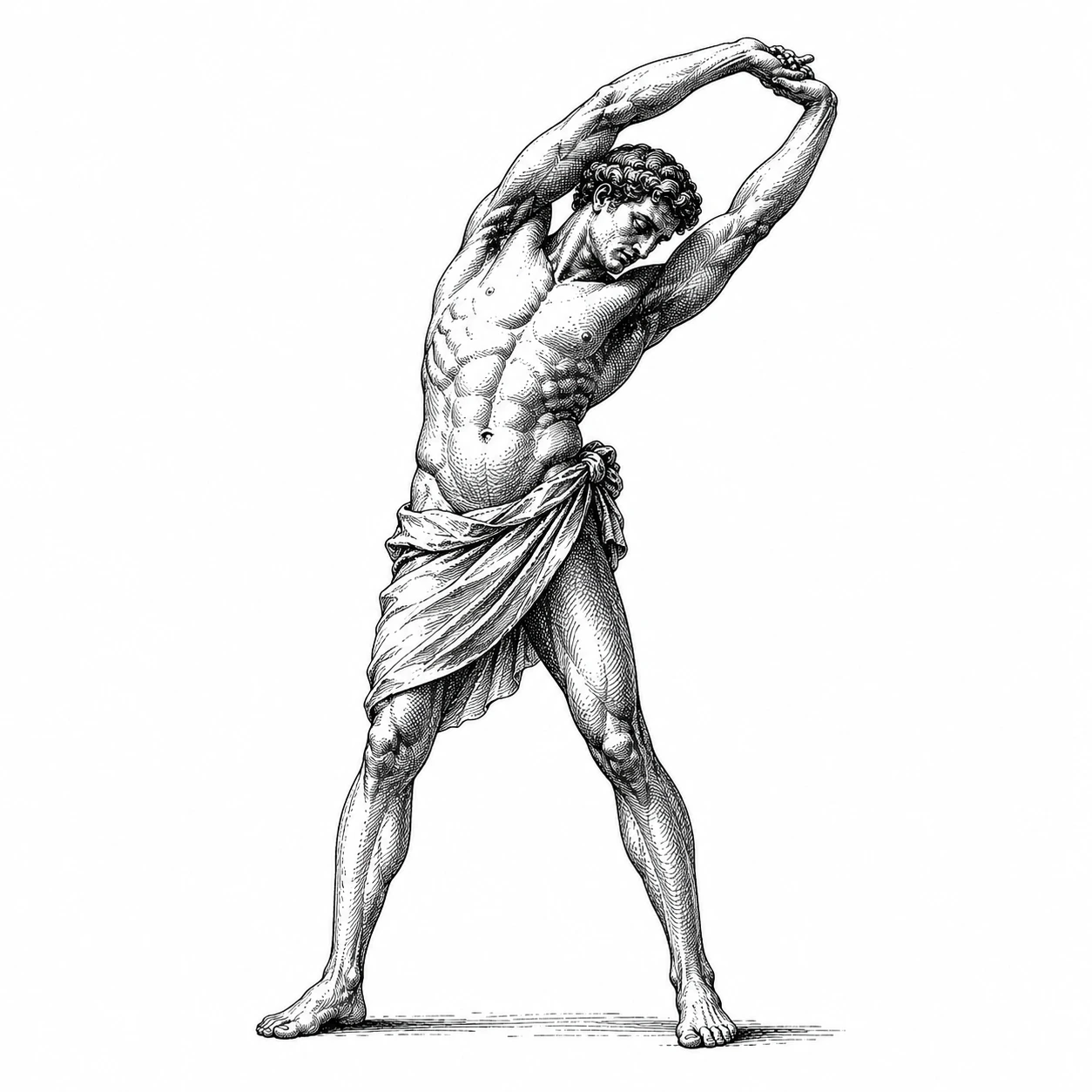
Pandiculation is one of the most ancient and overlooked biological movements of the body. It appears across species as a spontaneous pattern of stretching, stiffening, yawning, extension, and neuromuscular reset. In humans, it is usually experienced as the natural stretch that happens after sleep, immobility, fatigue, or transition between states of consciousness.
This page gathers some of the strongest scientific resources currently available on pandiculation, from animal behaviour studies to myofascial hypotheses, fetal movement research, yawning physiology, and neurological observations.
The purpose is not to reduce pandiculation to one theory, but to create a grounded bibliography for those interested in the biological intelligence of stretching, tremor, fascia, and self-regulation.
Essential Papers on Pandiculation
Pandiculation and the Myofascial System
This is one of the most important modern papers on pandiculation. Bertolucci proposes that pandiculation may help maintain the functional integrity of the myofascial system by restoring coordination, fascial pre-stress, and neuromuscular readiness. The paper defines pandiculation as involuntary stretching of soft tissues and links it to the stretch-yawning syndrome and locomotor regulation.
- Bertolucci, L. F. (2011). Pandiculation: Nature’s way of maintaining the functional integrity of the myofascial system? Journal of Bodywork and Movement Therapies, 15(3), 268–280. https://doi.org/10.1016/j.jbmt.2010.12.006
Pandiculation as Systematic Stretching Across Species
Fraser’s paper is foundational because it frames pandiculation as a comparative biological phenomenon, not just a human habit. It describes coordinated stretching patterns across domestic mammals and identifies pandiculation as a homologous behaviour between humans and animals.
- Fraser, A. F. (1989). Pandiculation: The comparative phenomenon of systematic stretching. Applied Animal Behaviour Science, 23(3), 263–268. https://doi.org/10.1016/0168-1591(89)90117-2
Fetal Pandiculation in Sheep
This study is powerful because it shows pandiculation before birth. Fraser observed fetal pandiculation in sheep and described it as similar to postnatal systematic stretching. The study found full and partial pandiculation events and suggested that fetal pandiculation may relate to transitions between sleep-like and alert states.
- Fraser, A. F. (1989). The phenomenon of pandiculation in the kinetic behaviour of the sheep fetus. Applied Animal Behaviour Science, 24(2), 169–182. https://doi.org/10.1016/0168-1591(89)90044-0
Pandiculation in Spiders
This newer paper expands the biological relevance of pandiculation beyond mammals. Nagayama and Takasuka reported confirmed pandiculation in four araneoid spider species, suggesting that pandiculation may be more widely distributed across species than previously assumed.
- Nagayama, S., & Takasuka, K. (2021). New reports of confirmed pandiculation by spiders. Acta Arachnologica, 70(2), 131–132. https://doi.org/10.2476/asjaa.70.131
Yawning, Pandiculation, and Biological Transitions
Walusinski’s work is relevant because yawning and pandiculation often appear together. His research connects yawning and pandiculation with rhythmic life transitions such as sleep-wake cycles, feeding, and sexuality, framing them as neuro-muscular behaviours related to homeostasis.
- Walusinski, O. (2006). Le bâillement: Quand, comment, pourquoi? Médecine du Sommeil, 3(10), 29–37. https://doi.org/10.1016/S1769-4493(06)70084-X
Automatic Pandiculation in Hemiplegic Patients
This early neurological paper is historically important because it observes automatic pandiculation in hemiplegic patients. It shows that pandiculation has long been noticed in neurology, especially in relation to involuntary motor phenomena and reflexive movement patterns.
- Bertolotti, M. (1905). Étude sur la pandiculation automatique des hémiplégiques. Revue Neurologique, 2(19), 953–959.
Recommended Reading Order
For a strong understanding of pandiculation, start with:
- Bertolucci, 2011 — best modern bridge between pandiculation, fascia, and movement therapy.
- Fraser, 1989 — best comparative animal behaviour foundation.
- Fraser, 1989 fetal study — best developmental / prenatal perspective.
- Walusinski, 2006 — best yawning and state-transition context.
- Nagayama & Takasuka, 2021 — best evidence that pandiculation extends beyond mammals.
- Bertolotti, 1905 — best historical neurological reference.
Why This Matters
Pandiculation is beyond “stretching.” It is a coordinated biological action involving the nervous system, soft tissue, fascia, breath, arousal, posture, and state transition. It appears when the organism is moving from one internal condition into another: sleep to waking, immobility to movement, dullness to alertness, contraction to readiness. In this sense, pandiculation may be understood as a natural reset mechanism of the living body. It is one of the clearest examples of how the body does not only move mechanically. It self-organizes, recalibrates, and restores functional coherence through instinctive movement.